9 min read
You're a Florida AAU director, eight weeks from the first practice session. Twenty-three coaches and volunteers need to be cleared before anyone steps on the court. The problem: clearance doesn't come from one place. Three separate agencies issue three separate credentials, each on its own renewal schedule. One lapse and you don't just fail an audit. You have a coach on the floor who shouldn't be there.
This article breaks down the three compliance systems every Florida basketball director must track, walks through the specific requirements of each, and provides an 8-week pre-season compliance sprint you can hand to your staff on Monday morning.
The three compliance systems every FL basketball director must track
Florida basketball programs that operate as independent sanctioning authorities (ISAs) sit at the intersection of three compliance requirements. Each comes from a different authority, renews on a different cadence, and carries a different consequence when it lapses.
|
System |
Issuing Authority |
Renewal Cadence |
Consequence of Lapse |
|---|---|---|---|
|
Level 2 background screening |
FDLE / AHCA Clearinghouse |
Continuous monitoring (no fixed expiration, but organizational record can lapse after inactivity) |
Coach must be removed from all youth contact until cleared |
|
SafeSport certification |
U.S. Center for SafeSport (via USA Basketball) |
Annual (core course first year, refresher each subsequent year) |
Coach must cease all activity until renewed |
|
Concussion awareness training |
ISA responsibility under FL Statute 943.0438(2)(e) |
Per organizational policy (no state-mandated renewal interval for ISAs) |
Liability exposure in concussion incidents, potential insurance coverage gaps |
The reason these three systems cause so many compliance gaps: they don't talk to each other. FDLE doesn't know about your coach's SafeSport status. The U.S. Center for SafeSport doesn't track concussion training. And no single agency sends you a consolidated roster showing who is fully cleared and who isn't.
System 1: FDLE Level 2 background screening and why commercial checks aren't equivalent
This is the requirement most Florida basketball directors get wrong. A commercial background check from a consumer reporting agency is not the same as an FDLE Level 2 screening, even if the commercial check is FCRA-compliant.
Here's the difference. A Level 2 screening under Florida Statute 943.0438 requires fingerprint submission through a LiveScan provider. Those fingerprints are run through both FDLE's criminal history repository and the FBI's national database. A commercial background check typically searches county court records and national database aggregators, but it may miss Florida-specific criminal records depending on which counties are indexed.
What the statute requires:
- Every coach, assistant coach, manager, or referee authorized by an ISA to work with minors must complete a Level 2 background screening (FL Statute 943.0438).
- The definition of "athletic coach" is broad: anyone authorized to work in a coaching, assistant coaching, managing, or referee role for an ISA, whether paid or volunteer, who has direct contact with minors.
- Organizations must participate in FDLE's Volunteer and Employee Criminal History System (VECHS) program to submit and receive screening results.
- As of July 1, 2026, all Level 2 screenings must be processed through the Agency for Health Care Administration (AHCA) Background Screening Clearinghouse, a centralized system that enables screening results to be shared across participating programs.
- Documentation must be retained for a minimum of five years.
The "conditional start" risk: Some programs allow coaches to begin working while their background screening is still processing. This is a compliance risk, and a common one. Under the statute, a person who has not been background screened may only act as an athletic coach if they are under the direct supervision of a coach who has already passed screening. Treating a pending clearance as a green light without direct supervision puts your organization at risk.
Turnaround and cost: Fingerprint-based screenings processed through the Clearinghouse typically cost between $40 and $75 per person for new applicants (covering state fees, federal fees, LiveScan vendor fees, and fingerprint retention), with renewals running lower. Processing time varies, but directors should allow at least two to three weeks for a Level 2 screening to clear.
System 2: SafeSport certification for USA Basketball affiliates
If your Florida basketball program is affiliated with USA Basketball as its national governing body (NGB), every coach must hold a valid SafeSport certification. This is separate from and in addition to your FDLE background screening.
USA Basketball requires all coaches seeking a Gold Coach License to complete both a SafeSport course and a USA Basketball coaching course, plus pass a background screen through Sterling Volunteers. The SafeSport component follows the U.S. Center for SafeSport's training framework: a core course (approximately 90 minutes) in the first year, followed by an annual refresher course (approximately 30 minutes) each subsequent year.
The organizational tracking problem: SafeSport sends renewal reminders to individual coaches, not to organizations. This means you, the director, don't receive a notification when a coach's certification is about to lapse. You find out only when you manually audit your roster or, worse, when an incident surfaces and the coach's records don't hold up.
Consequence of lapse: A coach with an expired SafeSport certification must cease all coaching activity until they complete the required refresher. For USA Basketball Gold License holders, the license itself becomes inactive until both the SafeSport training and background screen are current. During peak registration months (April and May), USA Basketball's license fee can double, so coaches who wait until the last minute pay significantly more and risk a gap in their eligibility.
Which FL programs are affected? Any basketball program affiliated with USA Basketball as an NGB, including AAU basketball programs operating under USA Basketball's umbrella. If your coaches hold Gold Licenses or your teams compete in NCAA-certified events, SafeSport compliance is mandatory.
System 3: Concussion awareness training under Florida Statute 943.0438
Florida's concussion awareness requirements for private youth sports organizations (ISAs) are codified in FL Statute 943.0438, subsections (2)(e) through (2)(g). These provisions mirror the requirements in FL Statute 1006.20 (which governs public K-12 school athletics through the FHSAA) but apply them to ISAs directly.
What the statute requires of ISAs:
- Develop guidelines to educate coaches, officials, administrators, youth athletes, and their parents or guardians about the nature and risk of concussion and head injury.
- Adopt policies requiring a parent or guardian to sign an informed consent form annually before the athlete participates.
- Require immediate removal of any athlete suspected of sustaining a concussion from practice or competition.
- Prohibit return to play until a written medical clearance is obtained from an appropriate health care practitioner.
Approved training options: The CDC's HEADS UP to Youth Sports Coaches online training is a widely accepted, free concussion education course. Many Florida programs adopt it as their standard. Some NGBs and insurance carriers require sport-specific concussion training beyond the CDC course.
Why documentation matters beyond liability: In a concussion incident, your insurance carrier will likely ask for proof that the involved coach had current concussion awareness training. If you can't produce documentation, you may face both legal liability and a coverage gap. This isn't hypothetical. It's the scenario that turns a single concussion into an organizational crisis.
Renewal cadence: Unlike SafeSport's clear annual cycle, FL Statute 943.0438 does not specify a mandatory renewal interval for concussion training. The statute requires ISAs to develop their own guidelines. Best practice is to require annual refresher training and document completion dates for every coach and volunteer.
The pre-season compliance sprint: an 8-week timeline for FL basketball directors
This timeline assumes your first practice is on Week 0. Work backward.
Week 8: Initiate FDLE background screenings
- Submit LiveScan fingerprints for all new coaches, assistant coaches, and volunteers through your VECHS-registered organization.
- Allow two to three weeks for Level 2 screening results. Starting at Week 8 gives you a buffer for delays.
- Confirm that returning coaches have active status in the Clearinghouse. If any coach took a season off, their record may have gone inactive and require reactivation or rescreening.
Week 6: Audit SafeSport certification status
- Pull a roster of all returning coaches and check each coach's SafeSport expiration date.
- Flag anyone whose certification expires within 60 days and assign the refresher course immediately.
- For new coaches who need a USA Basketball Gold License, confirm they've initiated the background screen through Sterling Volunteers (7 to 10 business days typical, longer during peak months).
Week 4: Assign concussion awareness training
- Identify all coaches and volunteers who don't have current concussion training documentation on file.
- Assign the CDC HEADS UP course or your organization's designated concussion training.
- Set a completion deadline of Week 2 to leave time for follow-up with non-completers.
Week 2: Full compliance roster audit
- Run a complete roster check across all three systems: Level 2 screening, SafeSport, and concussion training.
- Categorize every coach as cleared, pending, or blocked.
- Blocked coaches (missing any of the three credentials) cannot be assigned to a team.
- Contact pending coaches directly. Don't rely on automated emails from external systems.
Opening day: No exceptions
- No coach is assigned to a team without all three systems confirmed and documented.
- Store all clearance documentation in a single, audit-ready location.
Mid-season: Monitor expirations
- Set automated reminders for any certification expiring before the season ends.
- SafeSport refreshers, in particular, can lapse mid-season if a coach's training anniversary falls during your season.
How automation eliminates the manual tracking problem
Managing three compliance systems manually usually means three separate spreadsheets, a chain of reminder emails that coaches miss, and no single source of truth.
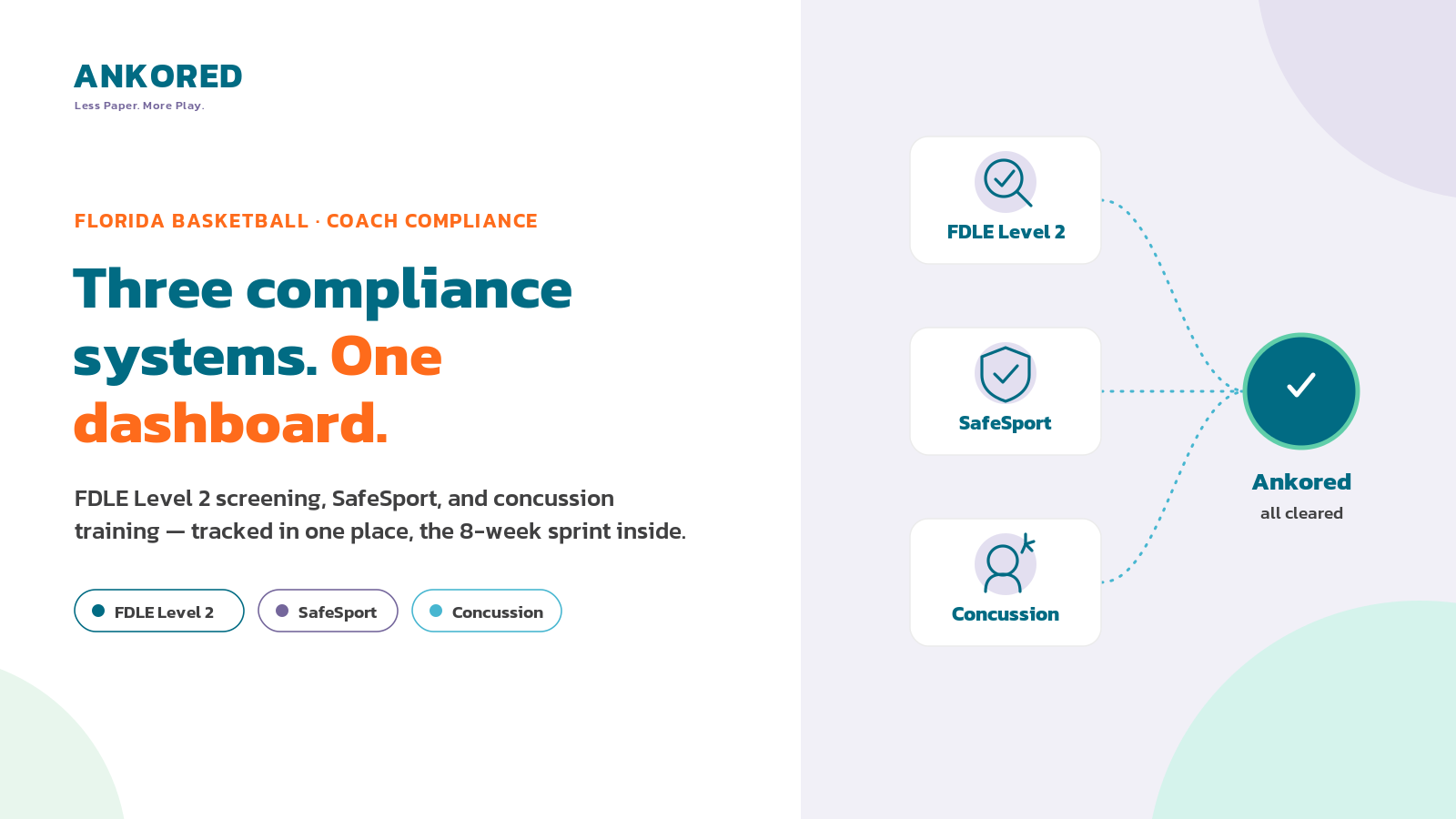
This is the problem Ankored was built to solve. Ankored centralizes background check tracking, SafeSport certification tracking, and concussion awareness documentation into one compliance dashboard. Automated reminders notify coaches before certifications expire. A required completion order locks each credential until the previous one is cleared, so coaches can't skip ahead before every requirement is satisfied. And when it's time for an audit, you export a single report instead of assembling evidence from three different systems.
For a Florida basketball director managing 20+ coaches across multiple teams, that's the difference between a Sunday night spent cross-referencing spreadsheets and a compliance status you can trust on sight.
Frequently asked questions
Can a commercial background check satisfy Florida's Level 2 screening requirement?
Not on its own. Florida Statute 943.0438 requires fingerprint-based screening through the FDLE/AHCA Clearinghouse. A commercial check (even an FCRA-compliant one) searches different databases and does not access FDLE's criminal history repository or the FBI's fingerprint records. Some organizations run both, but only the Level 2 screening satisfies the state requirement. Learn more about the different types of background checks in youth sports.
Do all Florida youth basketball coaches need SafeSport certification?
Only if your program is affiliated with USA Basketball as your NGB. AAU basketball programs operating under USA Basketball's umbrella require coaches to hold a Gold License, which includes SafeSport. Recreational leagues not affiliated with a national governing body are not subject to SafeSport requirements, though many adopt abuse prevention training voluntarily as a best practice.
How often does concussion training need to be renewed in Florida?
Florida Statute 943.0438 requires ISAs to develop concussion education guidelines but does not mandate a specific renewal interval. Best practice is annual renewal. Many insurance carriers and NGBs require annual documentation, and maintaining a 12-month cycle keeps your program aligned with SafeSport's annual renewal cadence. Review the safety policies every youth sports program should have in place.
What happens if a coach starts working before their FDLE screening clears?
Under the statute, a person who has not completed screening may act as a coach only under the direct supervision of a screened coach. Allowing unsupervised contact with minors before clearance is a compliance violation and creates significant liability exposure for your organization. Here's how to build a background check policy that closes this gap.
Your pre-season shouldn't start with a compliance scramble. See how Ankored automates coach certification and concussion training tracking for Florida basketball programs.