Takeaways from May 19th SERMA webinar with Steve Smith (Taft), Deanna Sheridan (3STEP Sports), Lisa McCoy (formerly Players Health), and Seth Lieberman (Ankored).
A youth sports operator can write the strongest policy in the country and still end up in court. The reason is almost always the same: nobody followed it.
That was the throughline of last week's SERMA panel. Four people who live inside the legal, operational, and field-level realities of youth sports safety spent an hour answering one question — what actually separates the organizations getting this right from the ones that aren't?
Here's what came out of it.
Risk in youth sports is a patchwork, and you don't get to opt out
Federal rules. National governing body standards. State mandates on background checks, AEDs, and cardiac arrest response. Local requirements that change at the county line. There is no single rulebook, and the provisions often conflict.
Steve Smith, a partner at Taft who works with national governing bodies and Olympic sport organizations, put the stakes plainly: the average judgment in youth sports cases that reach trial is approaching $5 million. Most organizations cannot absorb that.
He also named the most dangerous assumption directors make: we're small, we're under the radar, we don't need to do much. One incident ends that argument. And once you reach a jury — sympathetic to an injured minor, less sympathetic to your org — the small things compound.
Industry standard is a legal concept, not a marketing one. If background screening is the standard and you don't do it, you are negligent. Ignorance is not a defense.
Culture beats policy every time — but you still need the policy
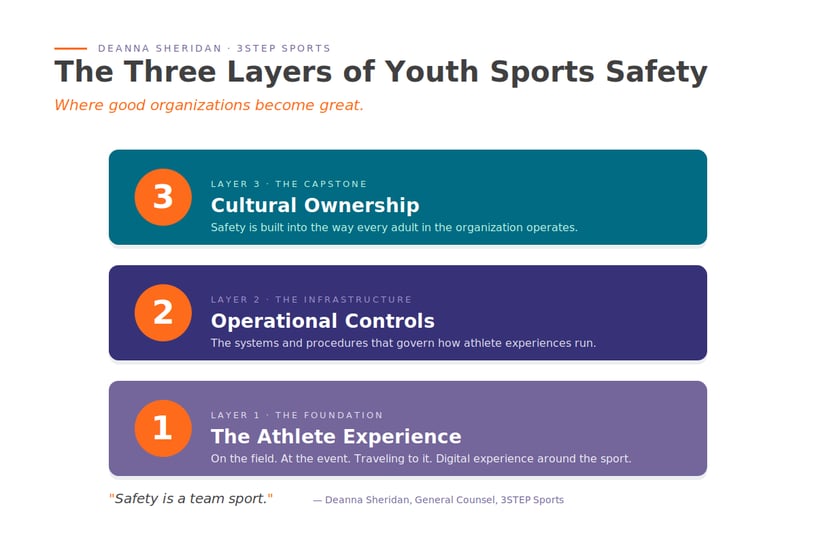
Deanna Sheridan, General Counsel at 3STEP Sports, runs risk for an organization with 1.5 million kids across seven sport verticals and more than 120 brands. Her framework breaks safety into three layers:
- The athlete experience — on the field, at the event, traveling to the event, and the digital experience around the sport.
- Operational controls — the systems and procedures that govern how those experiences run.
- Cultural ownership — when safety is not legal's job, not the risk team's job, not the coach's job, but built into the way every adult in the organization operates.
The third layer is where good organizations become great. And Deanna's phrase for it stuck: safety is a team sport.
Lisa McCoy, former AVP of Athlete Safety at Players Health, reinforced the same point from a different angle. A clear policy is a great place to start. A policy nobody reads is worse than no policy at all, because you've now created a written expectation you're failing to meet.
Steve put the legal version of that bluntly: the first law of sports law is to follow your policies. Writing a procedure you don't follow is the fastest route to a negligence finding.
The bare-minimum stack every youth sports operator needs
The panel kept coming back to a working definition of table stakes. Not best-in-class. Not aspirational. The floor.
- Annual background checks, with state-specific requirements built in. A check in Massachusetts doesn't cover what you need in Florida, California, or Pennsylvania, where fingerprint checks are required by law.
- Written policies and procedures covering one-on-one interactions, prohibited conduct, misconduct reporting, and an emergency action plan.
- Abuse prevention training for coaches, staff, and parents. Most coaches caught for grooming pass their background checks. Training is what catches the patterns a record never will.
- A response and resolution procedure that anyone in the organization can follow — including a way to report anonymously.
- Insurance you actually understand. More on this below.
If you're not at the floor, that's where you start. Lisa's closing advice: it's not as overwhelming as it feels. Get the first policy in place and the rest falls into line.
Indemnity contracts are not a safety strategy
The panel spent real time on a misconception worth naming directly. A lot of larger operators believe their downstream operators and affiliates have absorbed the liability because the contract says so.
Steve's read: releases of liability get invalidated by courts more often than people think, especially when a jury is sympathetic to a minor. Treat liability protection as a brick wall — incorporation, insurance, policies, enforcement, training. No single brick gives you immunity.
Deanna added the part the contract never covers: reputation. Even if your contract holds up legally, the press cycle and the social media cycle do not wait for a verdict. Registrations drop. Sponsors get nervous. Insurance premiums climb. That damage compounds long before the legal process resolves.
Insurance is getting harder, faster than most operators realize
Five years ago, $5 million in SAM (sexual abuse and molestation) coverage was attainable at a reasonable premium. Today, $1 million is the ceiling for many operators, and the cost is up roughly 30%. TBI coverage has followed the same trajectory in contact sports.
Deanna's guidance for anyone heading into a renewal:
- Read the policy. Not the summary. The policy.
- Check the sub-limits. $5 million in general liability with a $1 million SAM sub-limit is not $5 million in coverage where it counts.
- Check the exclusions. Steve described a client who had paid for a comprehensive policy that excluded sports-related injuries.
- Hire a risk manager for the renewal if you don't have one. The brokerage relationship is necessary but not sufficient.
A catastrophic claim doesn't just cost you the claim. It can leave you uninsurable. Uninsurable in youth sports means out of business.
The market is starting to reward operators who lead with safety
Seth shared a pattern Ankored sees across its book: organizations that lean into safety and stay ahead of the compliance curve grow faster, retain volunteers better, pay reduced insurance premiums, and see lower customer acquisition costs because parents return and refer.
Parents have more choices than ever. Clubs, leagues, tournaments, travel programs — the market has fragmented in a decade. That fragmentation gives families an exit. The operators getting safety right are the ones gaining share. The ones who treat it as overhead are losing it.
Whether federal regulation arrives, whether the state-by-state patchwork continues, or whether the market sorts it out on its own, the direction is the same. Safety is becoming a buying criterion.
The "when, not if" mindset
Seth named the part of this work nobody likes to say out loud: in youth sports, harm is a when, not an if. Sixty million kids. Forty billion dollars. The volume guarantees incidents.
We can’t stop harm in totality. The job is not to prevent every harm. The job is to make harm harder in the first place and to limit the damage when something happens. That requires:
- Every adult in the organization knows what to look for.
- Every adult knows where to report.
- Reports go up the chain quickly, not into a desk drawer for adjudication.
- Law enforcement is called when law enforcement should be called.
Deanna's framing: collect the information and hand it off. Most people freeze because they think they have to decide whether something is "real." They don't. They need to report it to someone who knows what to do next.
What the panel agreed you should do this week
Each panelist closed with one thing. Together they form a working checklist:
- Lisa: Don't shy away because you don't know where to start. Get the first policy in place. The rest follows.
- Steve: Survey what the industry is doing. If others are doing X and you're not, that's negligence waiting to happen.
- Deanna: Ask what's next. A policy in a drawer is not a policy. Write it, train it, communicate it, revisit it. Keep improving.
- Seth: You are not on an island. People in this space want to help. Use them.
The compliance landscape isn't getting simpler. Neither is the cost of getting it wrong.
If you're a director trying to figure out what your state actually requires, what your insurance actually covers, or what the floor looks like for your sport — start there. The cost of getting it wrong is now measured in millions. The cost of getting started is an afternoon.