
Florida Parks & Recreation directors heading into summer often have 300+ seasonal hires to onboard before camp starts: lifeguards, day camp counselors, athletics coaches, aquatics instructors. Every one of them needs a fingerprint-based Level 2 background screening under Florida Statute 943.0438 before stepping on a field or pool deck with a minor. FDLE's processing windows don't flex to meet your Memorial Day deadline, so the work to get there has to start earlier than it feels like it should. Here's how to plan it.
This is the operational problem that breaks generic HR tools in Florida. It is not a general "seasonal onboarding" challenge. It is a Level 2 sequencing problem with statutory consequences, specific vendor dependencies, and a turnaround window that shrinks every week you wait.
Here is how Florida parks and recreation directors can plan for it, step by step.
What Florida Statute 943.0438 Requires
Florida Statute 943.0438 requires independent sanctioning authorities (ISAs) and youth-serving organizations to conduct a Level 2 background screening on every current and prospective athletic coach, assistant coach, manager, referee, or volunteer who has direct contact with minors. The current statute text defines "athletic coach" broadly: anyone authorized to work with a youth athletic team, paid or unpaid, who has direct contact with one or more minors.
For parks and recreation departments, "direct contact with minors" covers most seasonal roles. Day camp counselors, swim instructors, and sports league referees all qualify. Landscape maintenance staff working without unsupervised access to children generally do not.
The Level 2 screening is fingerprint-based. It routes through both the Florida Department of Law Enforcement (FDLE) and the FBI for a national criminal history check. Results are measured against the disqualifying offenses listed in Florida Statute 435.04, which include sexual offenses, felony assault, child abuse, kidnapping, and dozens more categories.
The compliance deadline for Level 2 screening under 943.0438 is July 1, 2026, after multiple legislative extensions. Many Florida P&R agencies and ISAs are already screening through VECHS ahead of the mandate, and county-level ordinances may require Level 2 screening sooner. The Florida Recreation and Park Association (FRPA) has been tracking the legislative timeline and advising member agencies to begin onboarding into the Clearinghouse now.
How VECHS Qualification Works
Before your agency can submit Level 2 fingerprints, you need to be a qualified entity under FDLE's Volunteer and Employee Criminal History System (VECHS). VECHS is the mechanism that allows organizations serving children, the elderly, or the disabled to obtain state and national criminal history records for employees and volunteers.
Most established Florida parks and recreation departments already hold VECHS qualified-entity status. If your agency does not, you need to apply through FDLE, complete the user agreement, and receive your Originating Agency Identifier (ORI) numbers: one E-number for paid employees and one V-number for volunteers. The FRPA's fingerprinting guidance walks through this process in detail.
Smaller agencies that host partner programs, or municipal departments that have not previously screened at Level 2, may not have VECHS registration. Do not assume. Confirm your ORI status with FDLE's VECHS unit before you start scheduling fingerprint appointments. The current contact line and email are listed on FDLE's VECHS process and forms page.
The Level 2 Screening Workflow, Step by Step
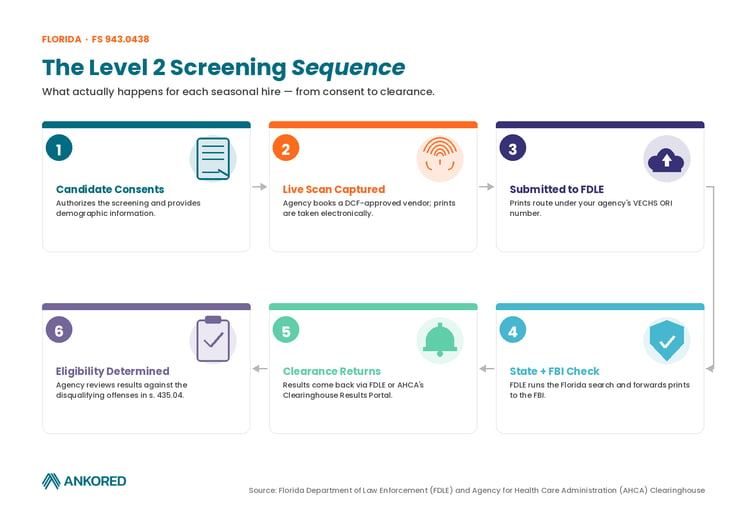
Here is what the actual sequence looks like for each hire:
- Candidate consents to the background screening and provides demographic information.
- Agency schedules a Live Scan appointment with a DCF-approved fingerprint vendor. Prints are taken electronically on a livescan device.
- Fingerprints submit to FDLE under your agency's VECHS ORI number.
- FDLE runs the state check and routes fingerprints to the FBI for a national criminal history search.
- FDLE returns clearance status to your agency (or, after the Clearinghouse transition, through AHCA's Clearinghouse Results Portal).
- Your agency makes the eligibility determination by comparing results against the disqualifying offenses in Section 435.04.
Typical costs run roughly $60 to $90 per screening, depending on the livescan vendor. The FDLE state search fee is $24, the FBI federal portion is set per the FDLE Criminal History Record Check Fee Schedule, and livescan vendor service fees add another $20 to $50 on top of the state and federal portions.
During peak season (April through June), turnaround stretches. FDLE publishes a service standard of up to five business days for non-certified checks, though most match-free electronic submissions process within 48 to 72 hours. Neither figure includes livescan vendor scheduling backlogs.
Now multiply that by 300. If even 5% of prints get rejected for quality and need resubmission, you are looking at 15 additional cycles layered on top of an already tight window.
Continuous Monitoring: The Gap Generic Onboarding Tools Miss
A Level 2 screening tells you someone was clear on the day their prints were processed. It says nothing about what happens in week six of camp.
This is where FDLE's Applicant Fingerprint Retention and Notification Program (AFRNP) comes in. When your agency elects to retain fingerprints through AFRNP, FDLE compares all incoming Florida arrest records against your retained prints. If one of your cleared staff members is arrested mid-season, FDLE notifies your agency. As of April 2025, FDLE also participates in the FBI's National Rap Back program, extending arrest notifications to the federal level.
There's a small ongoing cost: the AFRNP retention fee is $6 per person per year (waived in the first year of participation), charged on the anniversary of the applicant's initial entry into the program.
The Florida Care Provider Background Screening Clearinghouse, administered by AHCA, provides the same function: immediate arrest notifications routed to current employers listed on the Clearinghouse roster. You only receive notifications if you have added the employee to your roster and maintained their employment history in the system.
This is the operational gap most directors do not discover until something happens. A one-time screening clears a candidate. Continuous monitoring catches what happens after. Most general onboarding software handles the first task but has no mechanism for the second.
The Florida Seasonal Calendar: Work Backward From June
Florida summer camp programs typically launch in early to mid-June. Working backward from a June 9 start date, here is a realistic sequencing timeline:
January: Confirm VECHS qualified-entity status. If you need to register or update your ORI, start now.
Mid-March: Open fingerprint scheduling for returning and new seasonal staff.
Early April: Issue conditional offers contingent on Level 2 clearance. Initiate screening submissions.
Mid-May: Complete eligibility determinations for all roles with unsupervised minor access. Flag any resubmissions.
Memorial Day week: Staff orientation for cleared personnel.
Florida's hurricane season (June through November) adds another variable. Agencies running dual programming for summer camps and winter holiday camps need to plan two hiring surges, not one. The winter cycle often gets less attention but carries the same screening requirements.
Why a Multi-Vendor Stack Strains Under Florida Volume
Here is what the typical four-vendor approach looks like for a Florida P&R department:
- A general HR system for I-9 verification and payroll
- A screening vendor for Level 2 fingerprint checks
- A learning management system for required trainings
- A recreation management platform for program assignment
Each tool does its job. None of them talk to each other about the thing that matters most: is this person cleared to be alone with kids in this program, right now?
The failure modes are specific to Florida's requirements:
Clearance status lives in the screening vendor's portal, not in the staff record your program supervisors actually check.
AFRNP arrest notifications route to the VECHS entity contact, not to the P&R supervisor managing the summer camp where the flagged employee works.
Mid-season program transfers lose their clearance audit trail. A counselor who moves from aquatics to athletics in July does not automatically carry their screening record, their training completion, and their role-based access flag into the new program.
Audit preparation requires pulling records from four systems and reconciling them manually. When an incident occurs or an insurance carrier asks for proof of due diligence, a four-vendor stack becomes a four-hour scavenger hunt.
Across 300 hires, that adds up to more than an administrative burden; it's a meaningful operational risk that's worth addressing before the season starts.
Buying-Decision Framework for Florida P&R Directors
If you are evaluating systems to handle this workflow, here is what to look for:
Level 2 / FDLE VECHS workflow support. Can the system initiate and track fingerprint-based screenings under your agency's ORI?
AFRNP and rapback notification handling. Does the platform surface mid-season arrest notifications alongside the staff record, or do those alerts sit in a separate system?
Eligibility determination tracking against 435.04. Can you document and store the eligibility decision, not just the screening result?
Role-based unsupervised-access flags. Can you tag which roles require Level 2 screening and which do not, so the system enforces compliance at the role level?
Mid-season program-transfer audit trail. When staff move between programs, does their clearance record follow them?
FDLE-format audit export. Can you produce a clean report for insurance carriers, county risk managers, or FDLE auditors on demand?
FCRA and GLBA posture. Does the vendor handle adverse-action notices and data security requirements for consumer reports?
Volunteers and contractors in the same system. Can you screen paid staff, volunteers, and contracted instructors through one workflow?
One Record Per Staff Member, One Clearance Trail
A Florida P&R director's job between March and May is not managing software. It is sequencing 300 screenings against a fixed deadline with statutory consequences for getting it wrong.
Ankored centralizes the Level 2 screening status, continuous monitoring notifications, role-based unsupervised-access flags, and the audit-ready record per staff member into one workflow. One place to check clearance. One place to receive alerts. One trail that follows every staff member from hire through separation, across every program they touch.
See Ankored in action with a Florida livescan compliance workflow.

FAQs
What is a Level 2 background screening in Florida?
A Level 2 background screening is a fingerprint-based criminal history check conducted under Florida Statute 435.04. It includes submission of fingerprints to both FDLE and the FBI for state and national criminal history searches, plus a check against sexual predator and offender registries. Results are compared to a list of disqualifying offenses that include sexual battery, child abuse, felony assault, kidnapping, and other categories.
How much does a Florida Level 2 background check cost?
Total costs typically range from roughly $60 to $90 per screening. The FDLE state search fee is $24, the FBI federal portion is set per the FDLE Criminal History Record Check Fee Schedule, and livescan vendor service fees range from $20 to $50 depending on the provider and location.
When does Florida Statute 943.0438 take effect for youth sports organizations?
The Level 2 screening requirement under 943.0438 takes effect July 1, 2026, following legislative extensions in 2024 and 2025 (SB 1546). Many organizations and Florida P&R agencies are already screening through VECHS ahead of the mandate.
What is VECHS and do parks and recreation departments need it?
VECHS (Volunteer and Employee Criminal History System) is an FDLE program that allows qualified entities serving children, the elderly, or disabled individuals to obtain state and national criminal history records. Any Florida P&R department conducting Level 2 screenings needs VECHS qualified-entity status and an assigned ORI number. Most established departments already have it.
What happens if someone is arrested after passing a Level 2 screening?
If your agency participates in FDLE's Applicant Fingerprint Retention and Notification Program (AFRNP), FDLE retains the employee's fingerprints and compares them against all incoming arrest records. If a match occurs, FDLE notifies your agency. As of April 2025, this also extends to the FBI's National Rap Back program for federal-level arrest notifications. The annual retention fee is $6 per person, waived in the first year of participation.
Does a Florida Level 2 background screening expire?
The Level 2 screening result itself doesn't carry a fixed expiration date in statute, but its protective value depends on continuous monitoring. Without enrollment in AFRNP and the Clearinghouse, a Level 2 cleared on Day 1 doesn't reflect arrests that happen after the prints were submitted. Most Florida P&R agencies pair their initial screening with AFRNP retention so they receive arrest notifications throughout an employee's tenure.